.jpg)
Most families who have arranged care for a loved one know the feeling of opening a visit note and finding almost nothing in it. A carer comes and goes, and all that is left behind is a single line saying mum had a good day or dad was fine this morning, with no real sense of what that actually means or how that time was actually spent. For a son or daughter who cannot be there in person, that single line is often the only window they have into how their parent is truly doing, and it rarely tells them anything useful.
This is one of the most common frustrations families raise when they move from one home care provider to another, and it points to a problem that goes well beyond a single thin note. Before getting into that problem in detail, it helps to step back and answer a more basic question that a lot of families are still working through when they start looking into their options, which is what private home care in New Zealand actually includes and what it should genuinely deliver for the fees involved.
Private home care in New Zealand typically includes personal care, home help, nursing and clinical support, specialised care such as dementia or palliative support, and companionship, delivered with more flexibility and faster start times than government-funded care offers. In practice, that breaks down into:
Our own guide to home care in New Zealand sets these categories out in more depth for families who are still working out which level of support fits their situation.
What separates a good private arrangement from a government-funded one is less about the list of services and more about how those services are delivered. Private care typically starts within a day or two, rather than behind a Needs Assessment and Service Coordination waitlist. This gives families a genuine say over which caregiver comes into the home, rather than a rotating roster, and it can scale up or down as needs change without going back through a formal reassessment. Our earlier comparison of government funded and private in-home care covers this trade-off in more detail.
None of this actually means much, though, if the time behind those services is not genuine and the record of it is not trustworthy, which is exactly where a lot of families get let down after they have already signed up.
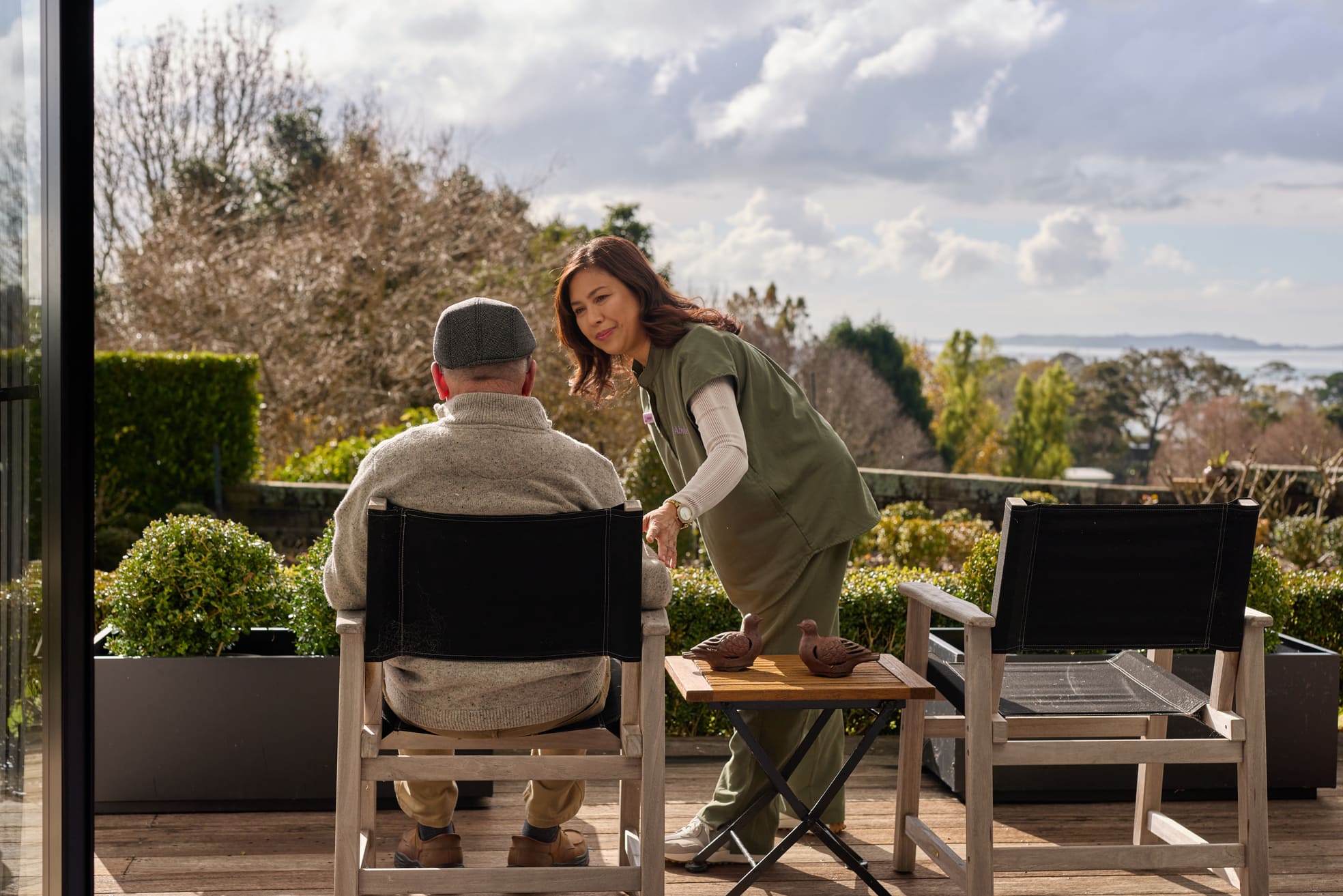
When visits are rushed and notes are thin, families are left to guess at how their loved one is progressing, doctors are working from an incomplete picture when they make clinical decisions, and small warning signs, a change in appetite, a new stumble, a shift in mood, can slip past unnoticed until they become much bigger problems. In other words, a provider can technically offer every service on the list above and still fail families.
Our carers and registered nurses work through a structured framework at every visit, built into the company's name to ensure nothing important gets missed.
ABODECARES covers ten specific areas:
Working through this list well takes time, and that is the point. Properly checking someone's appearance or noticing a change in behaviour cannot be rushed, so ABODECARES shapes the whole visit, not just the summary written at the end.
Every care plan at Abode is led by a Registered Nurse, and both the visit and the notes feed directly into ongoing clinical oversight rather than sitting in a folder unread, which is part of what genuinely distinguishes nurse-led home care from a more casual check-in service.
The same detail that reassures families also gives GPs and the supervising Registered Nurse a clear clinical trail to follow. As explained in our earlier piece on the difference between caregivers and Registered Nurses in home care, a caregiver's role is to provide daily practical support, while the Registered Nurse reviews and adjusts the care plan as needs change. That kind of clinical oversight only works if it is built on carers who have genuinely spent time with a client at every visit and reported accurately on what they observed, not an occasional summary written from memory.
This matters most with conditions that progress gradually rather than suddenly. Alzheimers New Zealand's own guidance on the warning signs of dementia makes the point that early changes can be subtle and genuinely hard to recognise, whether that shows up as a shift in mood, a lapse in a familiar routine or a change in how someone manages day-to-day tasks. That is exactly the kind of detail that only becomes visible when a carer has taken the time to properly engage with someone rather than simply checking in. Consistent ABODECARES documentation, backed by that time and attention, means those changes are far more likely to be caught early, discussed with the family, and acted on before they escalate.
It is a common experience for families who have previously used other home care companies to notice just how little time and detail went into each visit, often nothing beyond a brief check-in and a one-line comment. As Abode discussed in its recent piece on aged care reform in New Zealand, one concern raised by the Ministerial Advisory Group's report was inconsistency across a workforce that is not always closely regulated, and rushed visits with thin documentation are one of the clearest symptoms of that inconsistency in practice.
In everyday terms, this looks like a carer taking the time to properly sit with a client through lunch, noticing they ate less than usual and seemed a little more tired than the previous visit, details that on their own might seem minor but that, recorded consistently, allow the supervising nurse to spot a pattern and follow up before it becomes a bigger issue. It can just as easily be a carer spending extra time encouraging a short walk and noticing the client managed it with more confidence than the week before, since progress deserves the same attention as concerns do. None of this is intended to slow a visit down for its own sake; it is simply what genuine care and attention looks like when the services on offer are backed by real time rather than a rushed checklist.


